
- European Regional Development Fund (ERDF)
- 1 Jan 2018 to 31 Dec 2020
- Spain
Project page and source record Share by email Share on LinkedIn
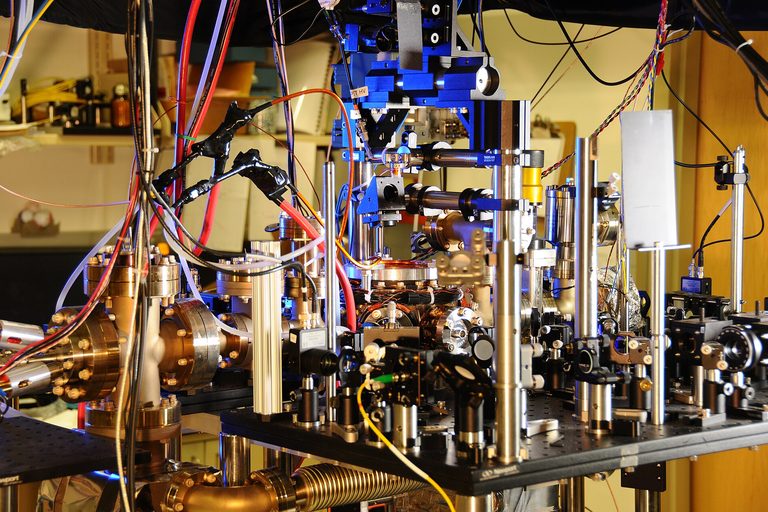
Operation co-funded by EU cohesion policy (European Regional Development Fund (ERDF)) under the programme Multi-regional Spain - ERDF (2014ES16RFOP002), managing authority: Subdirección General de Gestión del FEDER, de la Dirección General de Fondos Europeos del Ministerio de Hacienda.. The source names no beneficiary for this operation. Location: Barcelona Province (NUTS ES511); Spain. Budget: total eligible expenditure EUR 107,087.31; EU co-financing EUR 53,543.656, as stated by the source. Runs 2018-01-01 to 2020-12-31. Source: Kohesio, EU cohesion policy projects managed by national and regional authorities (not CORDIS); selected because its summary names quantum technology. Summary from Kohesio (English machine translation by the source): Strontium is an alkali-earth atom with two valence electrons in its outer shell, resulting in ideal optical properties for developing various research lines in quantum optics and atomic physics. These include: (i) the study of quantum light-trapped atoms interfaces where collective interference effects play a central role, with applications in quantum memories, strongly correlated photon states and many-body metrology; (ii) the realization of quantum simulators with artificial gauge fields and long-range interactions exploiting Rydberg states. In this project, we request a compact atomic source for generating a beam of cold strontium atoms. The system should include: (i) an oven producing a collimated atomic beam; (ii) optical access for the implementation of transverse molasses cooling scheme, in order to increase the beam brightness, and for stabilizing spectroscopically a 461 nm laser on the atomic beam; (iii) a ¿Zeeman slower¿ to reduce the beam¿s longitudinal velocity; (iv) a two-dimensional magneto-optical trap to capture and deflect the cold beam with respect to the oven. This atomic source would enable the development of a novel experimental platform based on two-electron atoms, making new scientific collaborations and theoretical and experimental research lines possible in the Barcelona region.
Source: Kohesio (EU cohesion policy projects), European Commission, Directorate-General for Regional and Urban Policy (DG REGIO). Retrieved 2026-10-21. Licence: CC0 1.0 (Cohesion Open Data Platform, dataset 2014-2020 Kohesio projects). Selected metadata, adapted presentation; the publisher's record is authoritative. No endorsement by the source is implied. Licence: public domain dedication (CC0 1.0).
AI-assisted summary: The project involves a compact atomic source for generating a beam of cold strontium atoms, co-funded by the EU with a budget of EUR 107,087.31. It took place in Barcelona Province from January 2018 to December 2020, focusing on quantum optics and atomic physics. Suggested technology pillar: sensing. Generated by AI from the public source text; it may contain errors and the original source is authoritative.
Source: kohesio.ec.europa.eu · checked 21 Oct 2026 · AI-assisted summary