
- European Regional Development Fund (ERDF)
- 1 Jan 2019 to 31 Mar 2021
- Spain
Project page and source record Share by email Share on LinkedIn
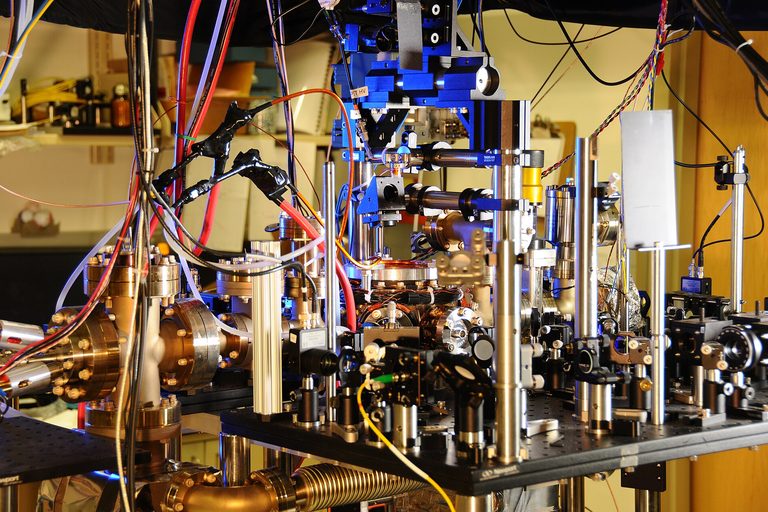
Operation co-funded by EU cohesion policy (European Regional Development Fund (ERDF)) under the programme Multi-regional Spain - ERDF (2014ES16RFOP002), managing authority: Subdirección General de Gestión del FEDER, de la Dirección General de Fondos Europeos del Ministerio de Hacienda.. The source names no beneficiary for this operation. Location: Barcelona Province (NUTS ES511); Spain. Budget: total eligible expenditure EUR 190,400; EU co-financing EUR 95,200 (co-financing rate 50%), as stated by the source. Runs 2019-01-01 to 2021-03-31. Source: Kohesio, EU cohesion policy projects managed by national and regional authorities (not CORDIS); selected because its summary names quantum technology. Summary from Kohesio (English machine translation by the source): Ultracold atomic gases constitute an ideal platform for quantum technologies, with applications in quantum simulation, quantum communications and quantum metrology. Trapping and manipulating ultracold atomic gases with light requires the use of continuous-wave lasers with very well defined specifications in terms of wavelength, spectral properties, and power. The goal of this project is the acquisition of the continuous-wave titanium sapphire laser required by three different research lines based on ultracold atomic gases: (i) quantum simulation of dynamical gauge fields in potassium Bose-Einstein condensates with tunable interactions; (ii) non-linear quantum optics with Rydberg states in ultracold rubidium gases, with applications in quantum information processing; (iii) ultracold strontium quantum simulators confined in optical lattices exploiting the clock transition normally used in metrology. The acquisition of this laser will favor the expansion of two existing research lines and allow the development of a third one that, until now, does not exist in Spain from the experimental point of view. Its installation will favor new scientific collaborations between theoretical and experimental research groups in the Barcelona region.
Source: Kohesio (EU cohesion policy projects), European Commission, Directorate-General for Regional and Urban Policy (DG REGIO). Retrieved 2026-10-21. Licence: CC0 1.0 (Cohesion Open Data Platform, dataset 2014-2020 Kohesio projects). Selected metadata, adapted presentation; the publisher's record is authoritative. No endorsement by the source is implied. Licence: public domain dedication (CC0 1.0).
AI-assisted summary: The project focuses on acquiring a continuous titanium laser sapphire for ultracold atom experiments, co-funded by the EU with a budget of EUR 190,400. It runs from January 1, 2019, to March 31, 2021, in Barcelona Province, Spain. Suggested technology pillar: sensing. Generated by AI from the public source text; it may contain errors and the original source is authoritative.
Source: kohesio.ec.europa.eu · checked 21 Oct 2026 · AI-assisted summary