
- Swedish Research Council
- 1 Jul 2019 to 1 Apr 2021
Project page and source record Share by email Share on LinkedIn
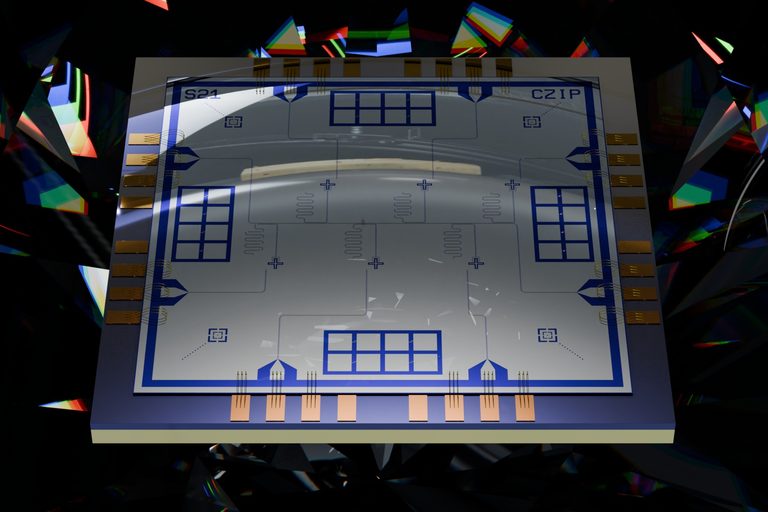
Project funded by Swedish Research Council (Grant for positions or stipends), grant 2019-00684_VR. Participating organisations named by the source: KTH, Royal Institute of Technology. Funded amount: SEK 1,837,500, as stated by the source. Runs 2019-07-01 to 2021-04-01. Keywords: Naturvetenskap, Natural Sciences, Fysik, Physical Sciences, Atom- och molekylfysik och optik, Atom and Molecular Physics and Optics. Source: OpenAIRE Graph, from the funder's project data (collected by OpenAIRE on 2025-12-04); national funding data, not CORDIS. Abstract given by the source: Quantum computing promises solutions to important societal problems involving chemistry, medicine, or logistics, and new applications such as a quantum internet. A quantum computer requires hundreds of identical quantum memories with switchable interconnections. However, quantum memories and their interconnecting circuits are very sensitive to their geometry, and even with the most advanced nanofabrication, no technology has yet achieved a large enough number of interconnected qubits to outperform classical computers.In this project, we use on-chip micromechanical (MEMS) tuning to tackle the scalability limitations of quantum computing. During the first year at MIT, we will develop a material platform that combines quantum memories based on diamond defects with quantum-compatible MEMS actuators and photonic integrated circuits (PICs). In year 2, we will demonstrate 1) spectral alignment of PIC-coupled quantum memories using MEMS-induced strain, and 2) MEMS-reconfigurable PICs. By the end of year 2, we will integrate these components into a quantum processing module, inherently scalable due to the use of MEMS. By year 3, we will demonstrate the first photonic quantum processor featuring 10 quantum memories, and scalable to thousands. This technology will open new avenues for quantum information processing, and bring us closer to large-scale quantum computing.
Source: OpenAIRE Graph: projects of national funders, OpenAIRE, from the project data of Swedish Research Council. Retrieved 2026-10-22. Licence: Creative Commons Attribution 4.0 (OpenAIRE Graph). Selected metadata, adapted presentation; the publisher's record is authoritative. No endorsement by the source is implied. Licence: Creative Commons Attribution 4.0 (CC BY 4.0).
AI-assisted summary: The project, funded by the Swedish Research Council with a grant of SEK 1,837,500, focuses on developing a mechanically-enabled quantum processor from July 2019 to April 2021, involving KTH, Royal Institute of Technology. Suggested technology pillar: computing. Generated by AI from the public source text; it may contain errors and the original source is authoritative.
Source: explore.openaire.eu · checked 22 Oct 2026 · AI-assisted summary