
- Swedish Research Council
- 1 Jan 2016 to 31 Dec 2025
Project page and source record Share by email Share on LinkedIn
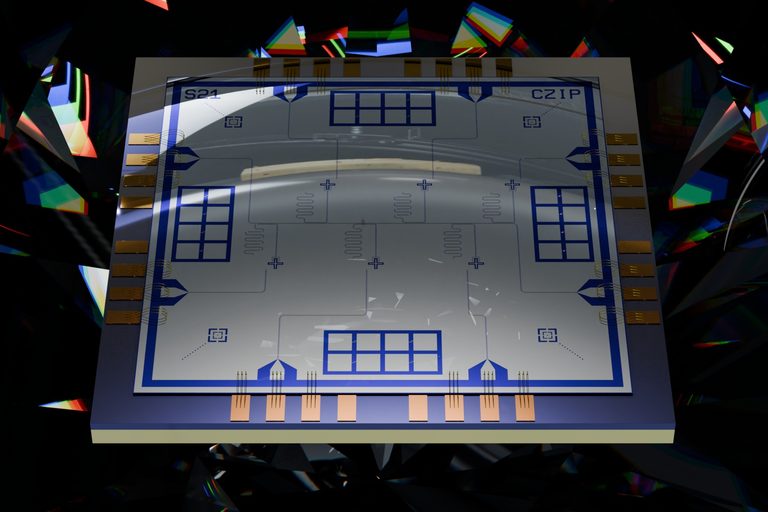
Project funded by Swedish Research Council (Research environment), grant 2015-00152_VR. Participating organisations named by the source: Chalmers University of Technology. Funded amount: SEK 46,700,000, as stated by the source. Runs 2016-01-01 to 2025-12-31. Keywords: Naturvetenskap, Natural Sciences, Fysik, Physical Sciences, Atom- och molekylfysik och optik, Atom and Molecular Physics and Optics. Source: OpenAIRE Graph, from the funder's project data (collected by OpenAIRE on 2025-12-05); national funding data, not CORDIS. Abstract given by the source: This application aims at developing new quantum circuits where sound, in the form of Surface Acoustic Waves (SAW), is studied at the quantum level. We use the unique properties of superconducting circuits, which can be engineered into superconducting qubits, or artificial atoms and let them interact with SAW. The interaction between SAW and the artificial atoms will allow us to create non-classical states of sound, manipulate phonons in flight, and study new regimes for artificial atoms. During the last decade, it has become possible to study quantum optics phenomena in the microwave domain. This new research area called circuit-QED, offers strong atom-photon interactions, very low dissipation due to superconductivity, and efficient guiding of photons in transmission lines. Many artificial atoms, transmission lines, and other devices can be integrated on one chip. In a parallel development, it has also become possible to study mechanical degrees of freedom in suspended beams and membranes at the quantum level. These experiments have all addressed localized modes. Here, we suggest to combine the circuit QED technologies with propagating surface acoustic waves. We focus on the quantum information encoded directly in the mechanical degree of freedom of the propagating SAW. The use of SAW extends the prospects of mechanical quantum processing to propagating phonons, which can potentially be used to in quantum information applications. Building on our experience of doing quantum optics on-chip, we now enter the area of quantum acoustics on-chip. Three years ago we showed that SAW waves can be studied at the single phonon level (M.V. Gustafsson et al., Nature Physics, 2012). More recently we have also demonstrated how SAW phonons can interact with superconducting qubits. In a series of experiments we could both demonstrate non-linear reflection of SAW on an artificial atom, and we could "listen" to a decaying atom (M.V. Gustafsson et al., Science, 2014). We have also [shortened; the full text is on the OpenAIRE page]
Source: OpenAIRE Graph: projects of national funders, OpenAIRE, from the project data of Swedish Research Council. Retrieved 2026-10-28. Licence: Creative Commons Attribution 4.0 (OpenAIRE Graph). Selected metadata, adapted presentation; the publisher's record is authoritative. No endorsement by the source is implied. Licence: Creative Commons Attribution 4.0 (CC BY 4.0).
AI-assisted summary: The project "Quantum sound: Generating and manipulating phonons at the quantum level" is funded by the Swedish Research Council with SEK 46,700,000 from 2016 to 2025, focusing on developing quantum circuits using Surface Acoustic Waves and superconducting qubits. Suggested technology pillar: computing. Generated by AI from the public source text; it may contain errors and the original source is authoritative.
Source: explore.openaire.eu · checked 28 Oct 2026 · AI-assisted summary