
- European Regional Development Fund (ERDF)
- 9 Sep 2021 to 31 Dec 2022
- Germany
Project page and source record Share by email Share on LinkedIn
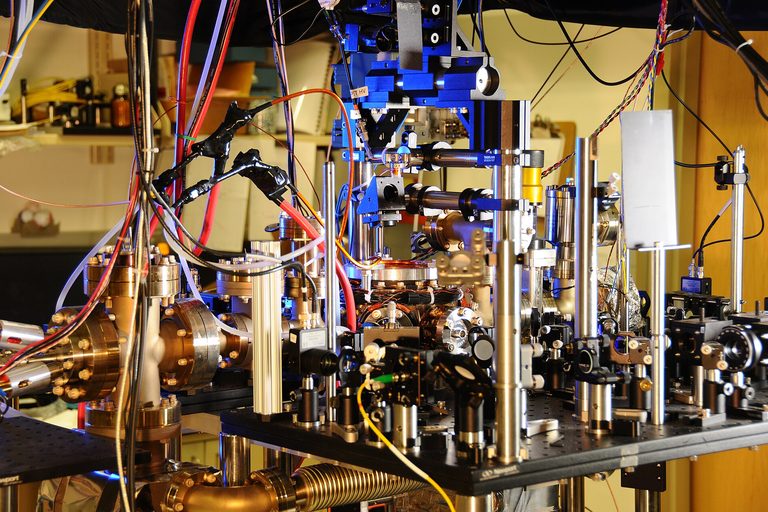
Operation co-funded by EU cohesion policy (European Regional Development Fund (ERDF)) under the programme Baden-Württemberg - ERDF (2014DE16RFOP001), managing authority: Ministerium für Ländlichen Raum und Verbraucherschutz, Referat 40 EFRE. Beneficiary: Universität Stuttgart. Location: Stuttgart (NUTS DE111); Germany. Budget: total eligible expenditure EUR 1,987,987, as stated by the source. Runs 2021-09-09 to 2022-12-31. Source: Kohesio, EU cohesion policy projects managed by national and regional authorities (not CORDIS). Summary from Kohesio (English machine translation by the source): Qubits are the basis of all quantum technologies. Magnetic molecules and spin centers in 2D materials are natural, identical quantum systems that can be produced cheaply and in large quantities. Its potential for quantum technology has so far been little explored, as its small size ( & 10 nanometers) makes it invisible to most measuring instruments. The large-scale device proposed here, QC.AFM, is specifically designed for the research of qubit networks, which can be generated by self-assembly of molecules or nano-manipulation of spin centers in 2D materials. QC.AFM is an ultra-low temperature atomic force microscope that enables quantum-coherent control of individual molecules and spin centers on surfaces using pulsed microwave excitation. For the first time, it will use the short-range magnetic exchange force between qubits and spin-sensitive atomic force probes to measure individual qubits in dense networks and in insulating environments.
Source: Kohesio (EU cohesion policy projects), European Commission, Directorate-General for Regional and Urban Policy (DG REGIO). Retrieved 2026-10-21. Licence: CC0 1.0 (Cohesion Open Data Platform, dataset 2014-2020 Kohesio projects). Selected metadata, adapted presentation; the publisher's record is authoritative. No endorsement by the source is implied. Licence: public domain dedication (CC0 1.0).
AI-assisted summary: The project involves an ultra-low-temperature atomic force microscope, QC.AFM, designed for researching qubit networks, co-funded by the EU with a budget of EUR 1,987,987. It is managed by Universität Stuttgart and runs from September 2021 to December 2022. Suggested technology pillar: sensing. Generated by AI from the public source text; it may contain errors and the original source is authoritative.
Source: kohesio.ec.europa.eu · checked 21 Oct 2026 · AI-assisted summary