The Qbead is a handheld qubit simulator designed to enhance understanding of quantum mechanics. It allows users to visualize and interact with the quantum state of a qubit through a point of light…
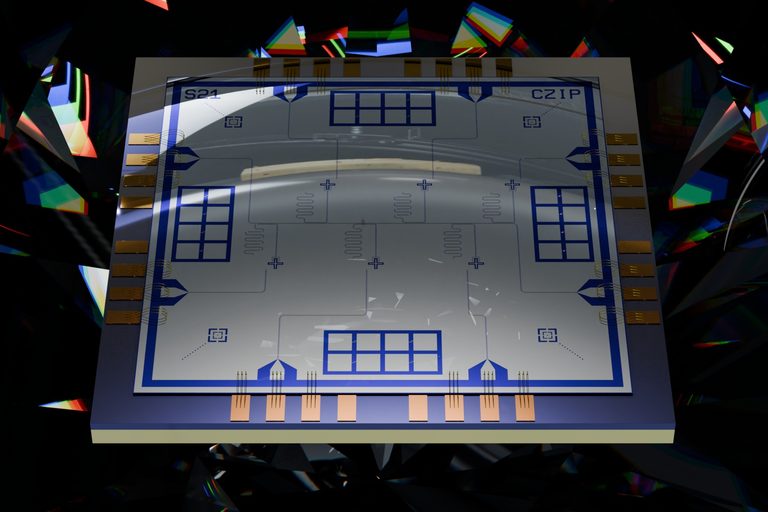
Researchers from Fujitsu, TU Delft, and QuTech have created a prototype quantum computer utilizing tin-vacancy centres in diamond. This system integrates diamond spin qubits with photonics on a chip…
Jakob Buchheim leads a team at DLR QT-IMN in Hamburg, focusing on establishing a User Facility for deep-tech startups. The project involves creating a specialized cleanroom that integrates 35 systems…
Researchers at the Institute of Science and Technology Austria, along with collaborators in Munich and Madrid, have demonstrated that two superconducting qubits can be entangled by exposure to the…
QuTech has launched a Quantum Systems Integration Unit aimed at developing full-stack superconducting quantum computers. This unit will utilize a European quantum value chain and is supported by…
The JION quantum computer was officially launched at Forschungszentrum Jülich, developed in North Rhine-Westphalia. It will be accessible to research institutions and industry via the JUNIQ user…
Barbara Terhal reflects on her early experiences in quantum computing during her PhD in Amsterdam, highlighting her recent month at QuSoft focused on quantum error correction. This research is part…
Stefano Polla has been appointed as an Assistant Professor at QuSoft, where he will focus on the development of quantum algorithms specifically for chemistry applications. This appointment is part of…
The QSea II project has achieved a significant milestone by demonstrating the controlled movement of a charged particle, specifically an ion, using electromagnetic fields. This advancement allows for…
The Technikum 6 at the Innovationszentrum Ulm provides over a dozen new laboratories for quantum technology startups. Managed by Kathrin Höppner, the facility features advanced infrastructure…
QuSoft’s scientific highlights for Quantum Physics and Logic 2026 feature Barbara Terhal on quantum error correction. Terhal began her PhD in Amsterdam in 1995, when quantum computing was still a…
Researchers in Austria developed a method to verify quantum simulations by quantifying uncertainty in predictions. Demonstrated on an ion-trap quantum simulator with up to 51 qubits, the approach…