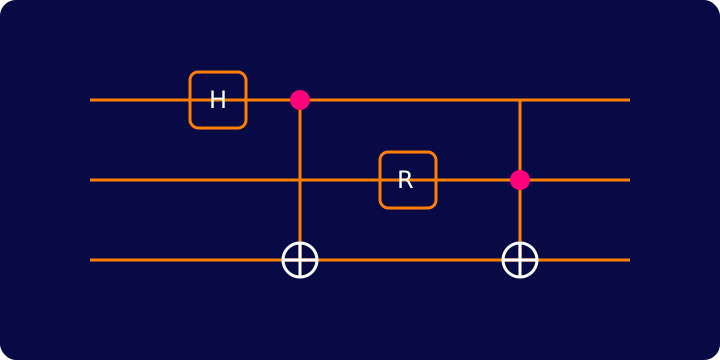
Qubit
The basic unit of quantum information; unlike a classical bit it can be in a combination of 0 and 1.
Superposition
A quantum state that is a combination of several possible states at once.
Entanglement
A correlation between quantum systems that persists even when they are separated.
Decoherence
Loss of quantum behaviour caused by interaction with the environment; the main obstacle to stable qubits.
Interference
Possibilities in a superposition adding up or cancelling out, like overlapping waves; quantum computers and sensors rely on it.
Coherence time
How long a quantum system keeps its superposition before decoherence destroys it.
No-cloning theorem
The rule that an unknown quantum state cannot be copied perfectly.
Superconducting qubit
A qubit made from a tiny electrical circuit that loses all resistance when cooled close to absolute zero.
Trapped ion
A charged atom held in place by electric fields and used as a qubit, controlled with lasers.
Neutral atom
An uncharged atom held by focused laser beams and used as a qubit.
Photonic qubit
A qubit carried by a particle of light, for example in its polarisation or path.
Quantum error correction
Methods that protect quantum information by spreading it over many physical qubits.
Logical qubit
A more reliable qubit built from many physical qubits with error correction.
Error correction threshold
The error rate per operation below which adding qubits for error correction lowers errors instead of adding to them.
NISQ
Noisy intermediate-scale quantum: today's devices with limited qubit numbers and no full error correction.
Quantum advantage
A task where a quantum computer outperforms the best known classical method in practice.
Quantum key distribution (QKD)
A method to share encryption keys using quantum states so that eavesdropping can be detected.
Post-quantum cryptography
Classical cryptographic algorithms designed to resist attacks by future quantum computers.
Quantum repeater
A device that extends quantum links over long distances without measuring, and so disturbing, the quantum states it passes on.
EuroQCI
The European Quantum Communication Infrastructure: secure quantum communication links across the EU, on the ground and via satellite.
Quantum sensing
Measurement techniques that use quantum effects for extreme sensitivity and accuracy.
Quantum simulator
A controllable quantum system used to study another quantum system.
Technology readiness level (TRL)
A 1 to 9 scale from basic research (1) to proven operational system (9).
CORDIS
The Community Research and Development Information Service of the European Commission.
Horizon Europe
The EU research and innovation framework programme for 2021 to 2027; Horizon 2020 covered 2014 to 2020.
Quantum Flagship
A large EU research initiative launched in 2018 to consolidate and expand European quantum research.
Quantum Europe Strategy
The European Commission's strategy of July 2025 to make Europe a global leader in quantum technologies by 2030.
EuroHPC Joint Undertaking
The EU body that pools EU and national funding for supercomputers and also procures quantum computers for them.
Chips Joint Undertaking
The EU body under the European Chips Act that, among other things, funds pilot lines for quantum chips.
QuantERA
A network of national research funders that runs joint calls for quantum research projects.
RIA / IA / CSA
Types of EU grant: research and innovation action, innovation action, and coordination and support action.
Technology pillar
One of the four groups in which the portal places quantum technologies, following the draft SRIA 2026: quantum computing and simulation, quantum communication, quantum sensing and metrology, and enabling technologies and supply chain.
Quantum computing and simulation
The pillar of quantum processors, error correction, algorithms and software, and of quantum simulators.
Quantum communication
The pillar of quantum key distribution, quantum random numbers, entanglement distribution and quantum networks.
Enabling technologies and supply chain
The pillar of what quantum devices are built from: chips and their fabrication, materials, cryogenics, photonics, control electronics and the software stack.
SRIA
Strategic Research and Industry Agenda: the Quantum Flagship's plan of research and industrial goals. The 2026 edition is a draft.
Quantum Act
EU legislation on quantum technologies that the Commission plans as a follow-up to the Quantum Europe Strategy.
Digital Europe Programme
The EU programme that funds digital capacities and infrastructure, including the quantum communication infrastructure EuroQCI.
EuroQCS
The European Quantum Computing and Simulation infrastructure: the quantum computers that the EuroHPC Joint Undertaking procures and connects to European supercomputers.
Pilot line
A facility that makes and tests new chips in small series before industrial production; the Chips Joint Undertaking funds pilot lines for quantum chips.
Maximum EU contribution
The highest EU grant agreed for a project in its grant agreement. It is not the amount paid out, and the portal's funding figures use it.
Participation
One organisation taking part in one project. An organisation in five projects counts five participations.
CPC
Cooperative Patent Classification: the scheme patent offices use to class patents by technology. The portal uses the classes for quantum technologies to find patents.
OpenAlex topic
A research topic that OpenAlex, an open catalogue of scholarly works, assigns to each publication. The portal uses quantum topics to count publications.
Each topic in Learn ends with its own short glossary.
Example content prepared for the Quantum Europe prototype. It is subject to IE Communications review before any external use.